
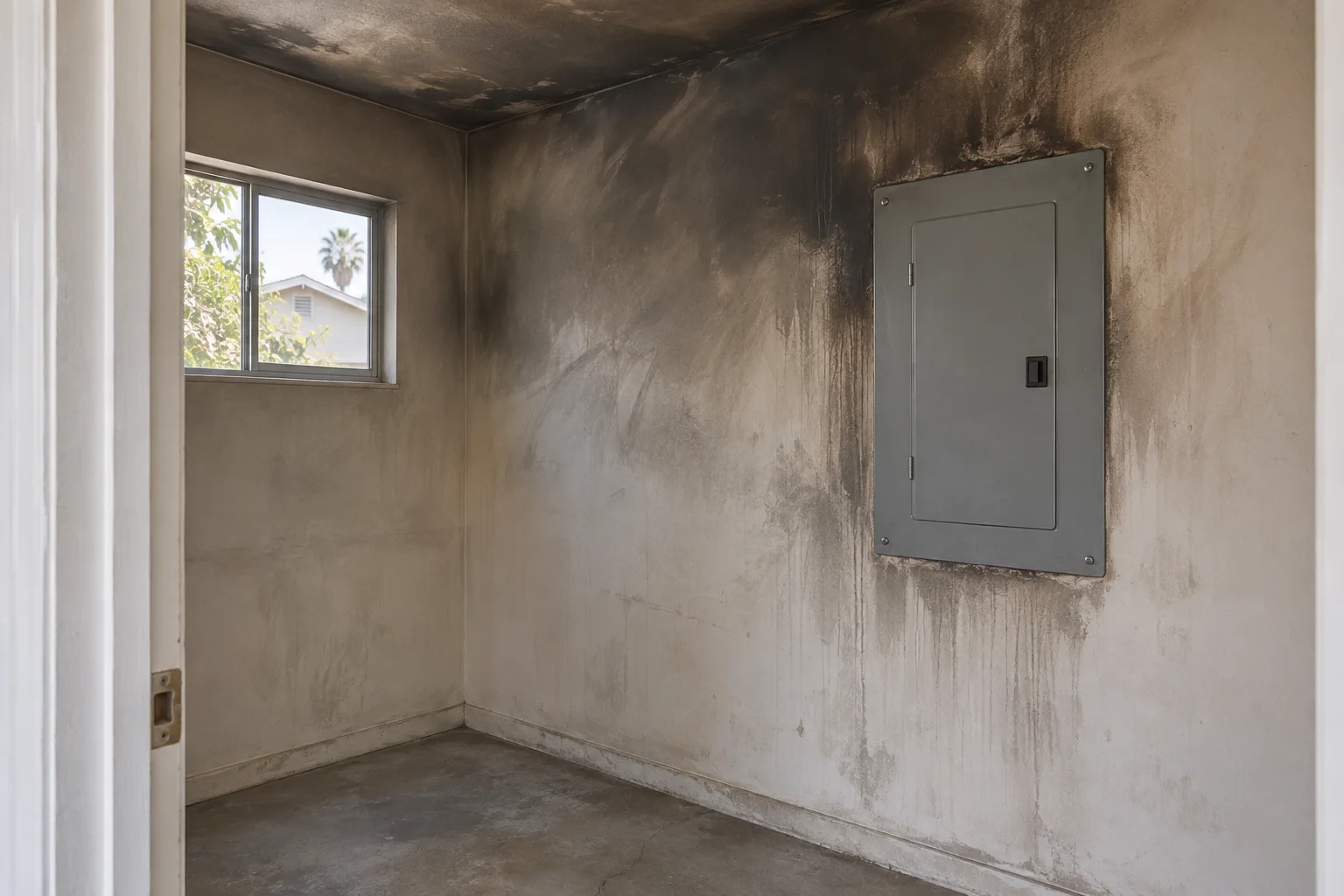
Confirm entry and electrical restrictions
Permission to enter a fire-damaged home and permission to restore electrical service are separate decisions. The U.S. Fire Administration advises waiting until the fire department says it is safe to enter. USFA: After the Fire If utilities were disconnected, the agency says not to turn them back on yourself. USFA: After the Fire Leave disconnected equipment and services alone, respect access restrictions, and ask the responsible professionals what happens next.
What the electrical assessment must account for
Firefighting water can affect belongings that did not burn, according to the U.S. Fire Administration. USFA: After the Fire Tell the electrician about the fire location and any reported heat, smoke or water exposure in adjoining rooms, including areas you cannot access. Do not enter a restricted area to investigate.
Water-damaged electrical equipment can remain hazardous even after it appears dry. Electrical Safety Foundation International: Water-Damaged Electrical Equipment ESFI recommends evaluation by a qualified electrician before power is restored. ESFI: Water-Damaged Electrical Equipment Drying the building alone is not an electrical clearance.
The National Electrical Manufacturers Association issued separate 2026 evaluation guides for water-damaged equipment and fire- or heat-damaged equipment. NEMA: Guidance on Evaluating Damaged Electrical Equipment Its guidance addresses manufacturer consultation and decisions about returning equipment to service or replacing it. NEMA: Guidance on Evaluating Damaged Electrical Equipment Leave the technical evaluation and application of manufacturer guidance to the qualified electrical contractor.
Identify the three points of contact
Qualified electrical contractor. Ask who will evaluate the property-side wiring, fixtures and equipment, what exposure information they need, and what their assessment includes or excludes. California identifies C-10 as the electrical contractor classification covering work such as electrical wiring and fixtures. California Contractors State License Board: C-10 CSLB provides a public license-status lookup. CSLB: Check a License Ask the contractor what license applies to the work and verify its current status.
Inspection authority. Ask the contractor and the building authority serving the property whether a permit or inspection applies, who requests it, and what documentation remains open. In the City of Los Angeles, LADBS says permit-required construction must be inspected before work is covered or concealed. LADBS: What is an inspection? This is a City example; other addresses may have a different authority. Do not assume every project has the same requirements or timeline.
Your actual utility. Ask who handles a service-side disconnect or safety hold, what the utility needs from the contractor or authority, and who will notify you when its requirements are resolved. For LADWP customers, the utility directs service inspection questions to the Electric Service Representative for the address. LADWP: Electric Services FAQs LADWP also says a safety-related hold can prevent service energization and directs customers to that representative to resolve it. LADWP: Electric Services FAQs LADWP is an example, not the utility for every Los Angeles County property; confirm the provider for your address.
Document the handoff
Imagine a fire in one room where firefighters had electricity disconnected. Suppression water may have reached an adjoining area, and a fixture or branch outside the burned room may need evaluation. The owner does not inspect or operate it; the owner records what was reported and asks the electrician to identify what was assessed, what was excluded and what remains open. This scenario illustrates coordination, not a diagnosis.
| Area | Reported exposure | Professional’s disposition | Open next step |
|---|---|---|---|
| Fire room | Heat and smoke reported | Await electrician’s written findings and scope | Name the responsible contact |
| Adjoining room or fixture | Possible suppression water reported | Ask whether this area was assessed or excluded | Record any further assessment and its owner |
Keep a separate row for each area or item. Record access restrictions, the date and source of each report, inspection milestones if applicable, and the next owner. Share the current record with your restoration coordinator without entering a restricted area for more information. A disposition for one area does not automatically resolve an unassessed area.
Coordinate restoration around the decisions
Two Eagles describes fire and smoke residue cleanup, firefighting water and the transition to repairs on its fire damage restoration service page. Share the electrical contractor’s written scope and any applicable authority or utility milestones so the restoration coordinator can discuss affected areas and sequence restoration work. The electrician, authority and utility retain their respective decisions; a restoration plan does not replace their findings or approvals. For a broader view of documented repair scope, see the fire damage restoration estimate guide.
Common questions
Does permission to enter mean power can be restored?
No. Entry permission and electrical restoration are separate decisions. Ask the responsible professionals, authority and utility about their respective requirements.
Is electrical equipment safe once it looks dry?
Appearance and drying do not establish electrical safety. Ask a qualified electrician to evaluate equipment exposed to water, heat or smoke.
Who decides whether service can be restored?
The qualified electrical contractor, applicable inspection authority and your utility each have different responsibilities. Ask each what remains open for your property.